
The powerful, new LS850 Microscope is the latest generation of our fully automated three-channel flagship model and offers the latest advances in optics, cameras, throughput, and user flexibility. The LS850 improves the image quality, motion speed, illumination, and software flexibility over the previous LS720 model. Exquisite XY motion control, motorized focus that allows autofocus and z-stacks, and easy-to-configure software combine to facilitate your automated microscopy experiments.
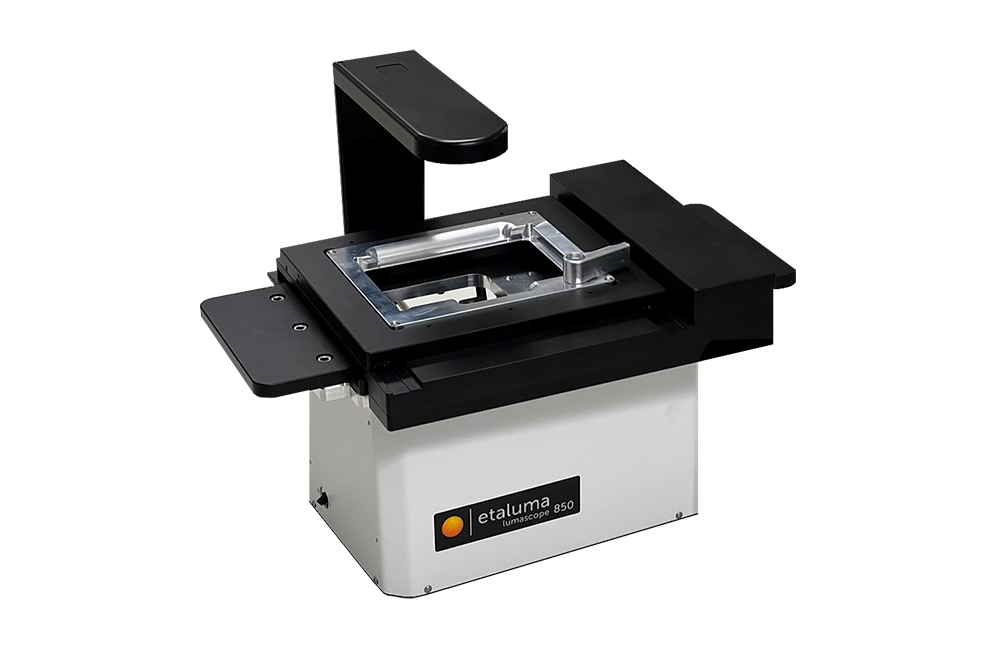
The LS850 in your incubator allows you to have a live cell imaging system that offers minimum photo toxicity and the most stable environment for long term imaging. Whether imaging multiple fields in your flasks or 1536 wells of cells with 3 fluorophores in a multi-day time-lapse, the LS850 offers a whole new world of walk-away automated microscopy!
Features and Benefits
Images, tiled images, Z-stacks, time-lapse series, and videos recorded directly to your computer
Bright field and phase contrast transmitted illumination
LED excitation and high performance optics provide diffraction-limited (theoretical maximum) resolution
Multi-OS software allows set-up and control across any locations, including microplates, microfluidic chips, slides, dishes, flasks, and deck-top chambers and custom arrays
High speed stage with single digit micron precision and accuracy
Long range motorized Z for autofocus and Z-stacks down to 100 nm
Compact and robust design enables use inside cell culture hoods, incubators, hypoxic chambers, and gloveboxes
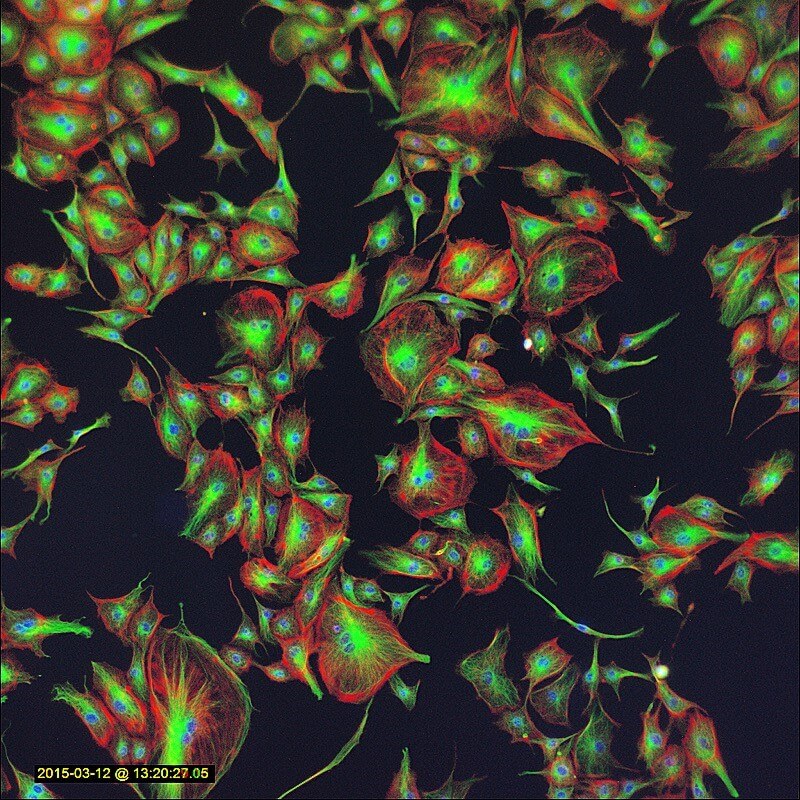
Detects blue, green and red fluorophores, including common probes such as Hoechst, DAPI, FITC, Fluo-4, GFP, Texas Red & mCherry GFP
Open source Python control code available
Objective compatibility with standard lenses and available with optional automated 4-objective turret
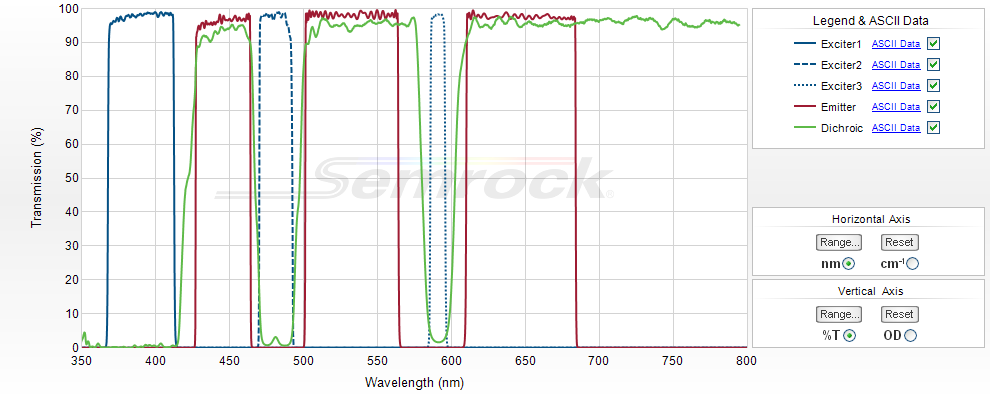
Like all of microscopes, the LS850 utilizes a Semrock Brightline® Pinkel filter set optimized for 405 nm, 488 nm, and 590 nm LED light sources. The 5-filter set is comprised of 3 excitation filters, 1 triple-band dichroic, and 1 triple-band emission filter. The LS850 use a 12 bit monochrome CMOS sensor.
Click here for LS850 Microscope Product Brochure.
Excitation and Emission Profiles of LS850 filters
| Specifications | |
|---|---|
| LED Excitation: | 405 nm, 488 nm, and 589 nm |
| Fluorescence Filters: | Blue: Excitation 370-410 nm, Emission 429-462 nm Green: Excitation 473-491 nm, Emission 502-561 nm Red: Excitation 580-598 nm, Emission 612-680 nm |
| Transmitted Modes: | Bright Field, Phase Contrast |
| Objectives: | 1.25x, 2.5x, 4x, 10x, 20x, 40x, 60x, and 100x(oil) |
| Camera: | High Sensitivity Monochrome CMOS BSI Sensor; 5 MP 12-Bit |
| Image Formats | JPG, BMP, TIF, or PNG |
| Image Size | Adjustable up to 2100 x 2100 pixels |
| Video Rates: | 25 FPS (exposure limited) |
| Automated XY Stage: | 120 mm x 80mm travel, 1-3 micron positional repeatability |
| Throughput: | 96-well, 3 channel fluorescence, w/o autofocus – 6 minutes 30 seconds |
| Motorized Z: | 14mm travel, 100 nm step, image-based autofocus, Z-stacks |
| Control Software: | LumaviewPro, multi operating system application |
| Computer Requirements: | Windows 10, 11; Core i7, 512GB SSD, 8GB RAM MacOS with M1; 512GB SSD, 8GB RAM |
| Linux Debian Distributions: | 512GB SSD, 8GB RAM |
| Power Requirements: | 80-264 V, 50-60 Hz 10W typical, 40W Max |
| Integration: | Python source under the MIT Open Source License |
| Dimensions: | 39.8 cm W x 29.7 cm D x 29.7 cm H [15.6 in W x 11.6 in D x 11.6 in H] |
| Weight: | 10 Kg/22lbs |
| Operating Conditions: | 0°C – 42°C, 5% – 95% RH non-condensing |