

Imaging chambers with a coverslip bottom
(#1.5 ibidi
Polymer or #1.5H glass); ideal for live cell imaging and
high-resolution microscopy on inverted microscopes.
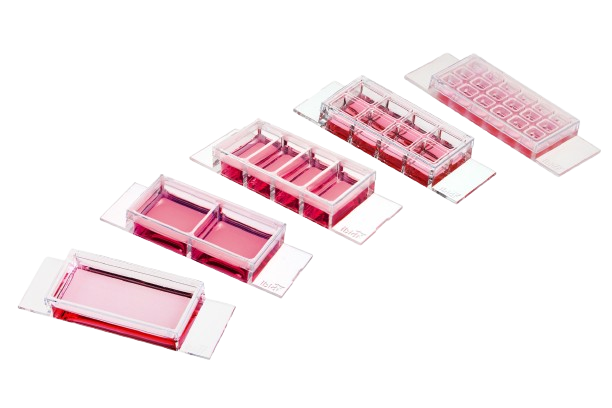
The Principle of Imaging Chambers: The Coverslip Bottom
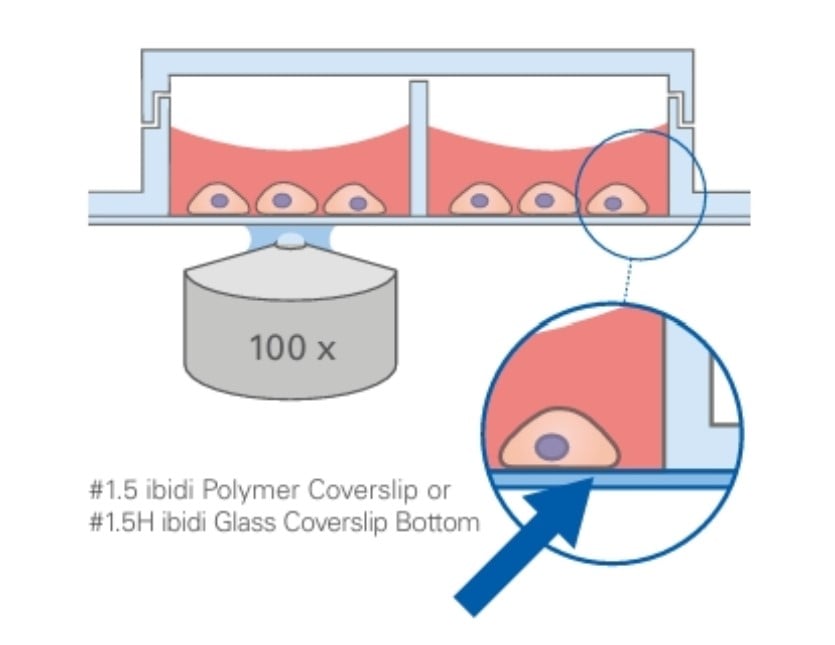
The outstanding characteristic of the ibidi μ-Slides, μ-Dishes, and μ-Plates is their thin coverslip bottom, which has ideal features for high-end microscopy applications. In comparison, the bottom of standard cell culture plastics has a thickness of about 1 mm—which is more than 5 times the thickness of the coverslip and, therefore, not ideal for imaging.
ibidi Polymer Coverslip
The ibidi Polymer Coverslip Bottom is suitable for various imaging techniques up to the highest resolution. With a standard #1.5 coverslip thickness of 180 μm (+10/ –5 μm), it meets all optical requirements for microscopes. The ibidi Polymer Coverslip is compatible with a variety of immersion oils, which are specified at ibidi.com/oil.
Surfaces and Coatings for the ibidi Polymer Coverslip
- ibiTreat (Tissue Culture-Treated): Excellent adhesion of adherent cells, hydrophilic surface with no need for any additional coating; optimal for everyday cell culture.
- Hydrophobic, Uncoated Surface: Weak adhesion of adherent cells, suitable for the application of specific coatings.
- Bioinert Surface: No adhesion of adherent cells or any biomolecule, stable long-term passivation; ideal for spheroid and organoid culture.
- Coated Surface: Culture of adherent cells on a Collagen I, Collagen IV, or Poly-L Lysine surface; available for selected μ-Slides
ibidi Glass Coverslip
The ibidi Glass Coverslip Bottom was developed specifically for TIRF, super- resolution microscopy, and single molecule microscopy. However, it is also ideally suitable for standard imaging techniques. The D 263 M Schott borosilicate glass has a #1.5H thickness of 170 μm (+/–5 μm) and unrestricted immersion oil compatibility.
- Glass Surface: Adhesion of adherent cells (coating might be required), ideal for special microscopy applications
Click here to explore ibidi’s range of imaging chambers, including the ibidi 8 well chamber slides.