

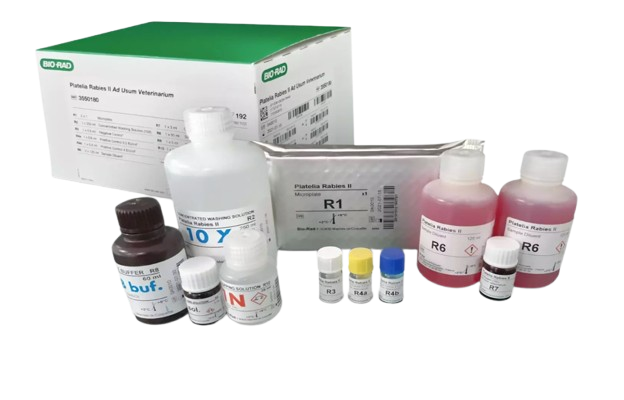
The Platelia Rabies II kit Ad Usum Veterinarium is an in vitro diagnostic ELISA test allowing detection and titration of IgG anti-rabies virus glycoprotein in animal (dogs, cats and foxes) serum and plasma. The kit can be used for qualitative analysis of 180 samples or quantatitive analysis of 160 samples. The kit contains two microplates, wash solution, negative control, 0.5 EU/ml positive control, 4 EU/ml positive control, sample diluent, conjugate, peroxydase substrate buffer, chromogen, stop solution, and adhesive plate sealing films. Controls are calibrated against OIE standards.
Principle
Platelia Rabies II Ad Usum Veterinarium is an immuno-enzymatic technique for the detection of rabies virus anti-glycoprotein antibodies. This assay can be carried out on the serum of several species of animals – dog, cat and fox. The test is based on the use of a solid phase enzyme immunoassay technique referred to as an indirect ELISA. A microplate is coated with rabies glycoprotein extracted from the inactivated and purified virus membrane. The enzymatic conjugate consists of a protein A from Staphylococcus aureus coupled with peroxidase. Positive controls, calibrated against OIE standard, allow the qualitative or quantitative determination of anti-rabies antibody titre in the serum.
Features & Benefits
Simplicity of the ELISA techique compared to virus neutralization
Rapidity: results available in less then 3 hours
Manipulation safety: no handling of live rabies virus
Highly reproducible results
Qualitative and quantitative protocol
A microplate is coated with rabies glycoprotein extracted from the inactivated and purified virus membrane
Used for Individual serology for international trade purposes and Confirmation of the vaccination status
Kit Components
– Microplate (R1) ; 2 plates
– Wash solution (R2) ; 1 vial (250 ml)
– Negative control (R3) ; 1 vial (0.6 ml)
– 0.5 EU/ml Positive control (R4a) ; 1 vial (0.6 ml)
– 4 EU/ml Positive control (R4b) ; 1 vial (0.6 ml)
– Sample diluent (R6) ; 2 vials (2 x 125 ml)
– Conjugate (R7) ; 1 vial (3 ml)
– Peroxydase substrate buffer (R8) ; 1 vial (60 ml)
– Chromogen (R9) ; 1 vial (5 ml)
– Stop solution (R10) ; 1 vial (28 ml)
– Adhesive films for microplates ; 6
Product Size
Enough reagents are provided for 2 x 96 assays. On each microplate, 90 samples can be analysed if a qualitative test is performed. Up to 80 samples can be quantified precisely for rabies antibodies if a quantification system is used.
Storage
All the components are stored at 2° to 8°C and can be used until the expiry date indicated on the kit. Reagent R2 (10 X) can be stored at 2° to 25°C before reconstitution.