

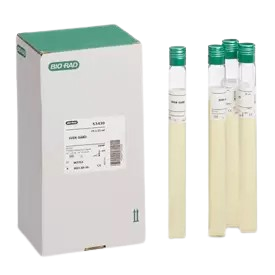
Sven Gard Agar is used for demonstrating the inapparent H antigen phase of biphasic Salmonella spp. (Sven Gard method) according to ISO Standard. This media is ready to use media.
Principle
The H antigens of Salmonella are either monophasic (the flagella of bacteria making up the culture
all have the same specificity, e.g: S. Typhi = O:9, H:12 [Vi] d) or biphasic (the bacteria can
alternatively express two different specificities; changes in specificity generally occur with a
frequency of the order of 10-5. e.g.: S. Paratyphi B = O:1,4,[5], 12 H:b:1,2 [z5], [z33]).
If a culture of a strain of Salmonella with a biphasic H antigen is composed of bacteria with
antigens in phase 1 and bacteria with antigens in phase 2 in roughly equal proportions, it can be
agglutinated by anti-H phase 1 and anti-H phase 2 sera for immediate identification. On the other
hand, if one of the two phases is markedly predominant over the other, only the major phase can be
identified. The immobilizing properties of the anti-H serum are used to detect the second phase. If
the anti-H serum corresponding to the specificity of the phase already identified is added to the
soft agar, and if this agar inoculated at one point, all the bacteria with a flagellate antigen
corresponding to the specificity of the added serum will be immobilized.
The others, however, can invade the agar and the H factors corresponding to the second specificity
can be identified. This method of selection by immobilization is currently referred to as phase
inversion.
Theoretical Composition
| Peptones | 12,7 g |
| Yeast extract | 1,2 g |
| Glucose | 1.5 g |
| Sodium chloride | 5 g |
| Agar | 4,6 g |
| Distilled water | 1,000 ml |
| Final pH at 25 ⁰C = 7.4 ± 0.2 |
Reconstitution Ratio
Ready to use media, 25 ml x 25 tubes
Storage
Store ready-to-use medium at 2-8 ⁰C in a dark place
References
– ISO/TR 6579-3:2014
– NF U47-100 July 2007
– NF U47-101 November 2007
– NF U47-102 January 2008